
“The long and often bloody struggle to achieve full equality for all citizens had no more effective advocate than Herblock.”
- Harry Katz [2]
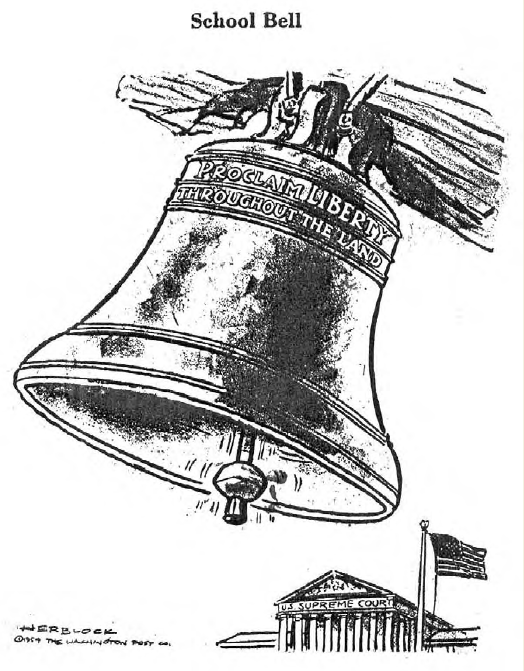
"On May 17, 1954, the United States Supreme Court ruled that public school segregation was unconstitutional in the case of Brown v. Board of Education. Let freedom ring."
|
Amidst battles in the courtrooms and on the streets, the struggle for civil rights was prominent in the 50s and 60s. Herblock’s cartoons depicted African Americans who continued to be oppressed in various ways: denial of housing, violence and voting rights. He felt he was responsible to draw what was unsaid: the prejudice against blacks occurred everywhere, even when whites didn’t care to admit it. Above all, he showed the people being hurt by discrimination, people being denied work and health care - he showed the rights of African Americans being violated. |
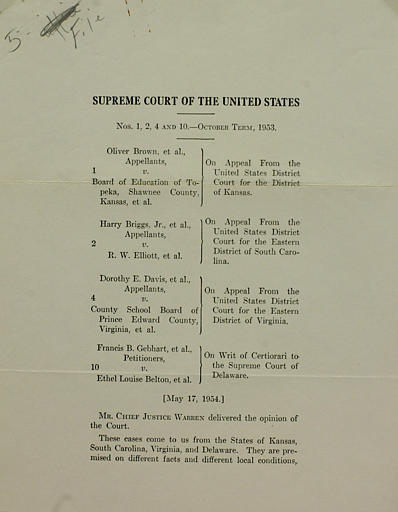
"An original document from the case of Brown v. Board of Education of Topeka..." (AP Photo)
|
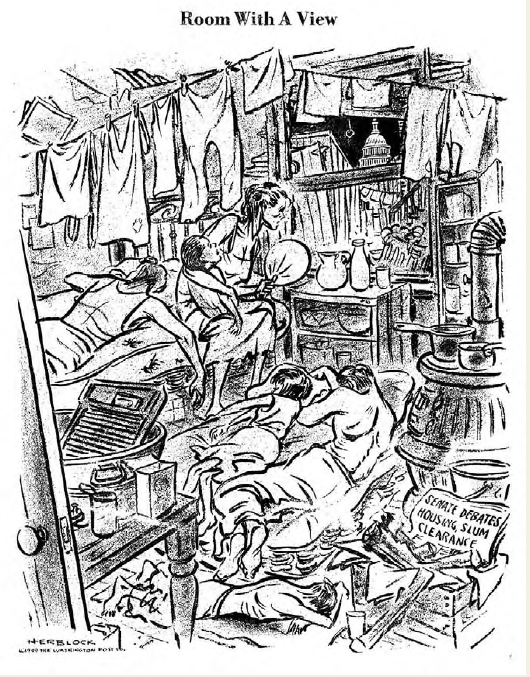
"In post-World War II in the U.S., the American dream of affordable housing and education were realized by many. Yet despite efforts to clear slums and replace them with low-cost public housing, inequities continued to exist in America's cities."
|
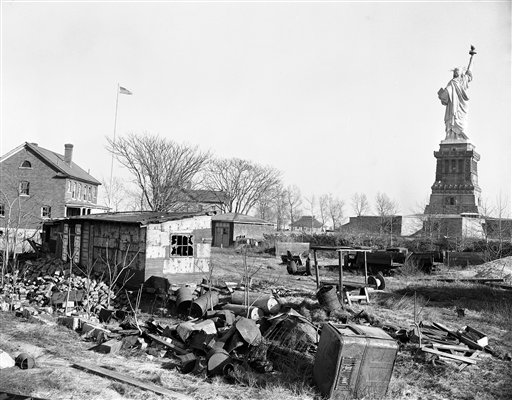
"The Statue of Liberty, towers above rubbish and junk on Bedloe's Island in New York Harbor on March 5, 1948. Congressmen have asked a House Appropriations committee for $1,000,000 for slum clearance on the island." (AP Photo)
|
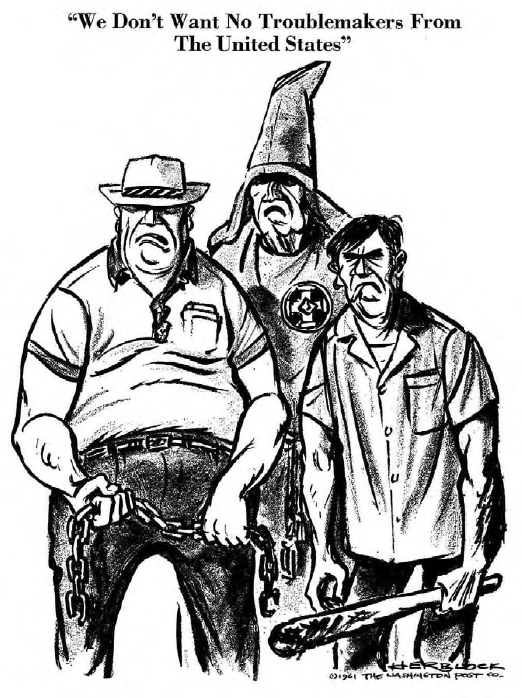
"Herblock used depictions of three armed thugs to criticize the mob that attacked the Freedom Riders - seeking integration of public transportation- in Montgomery, Alabama on May 21, 1961."
|
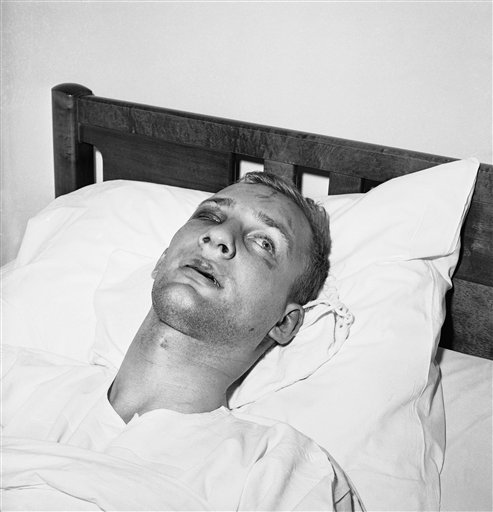
"Jim Zwerg, a "freedom rider" recuperates in hospital on May 21, 1961 in Montgomery, Ala. after he was beaten by a mob at the bus station..." (AP Photo)
|
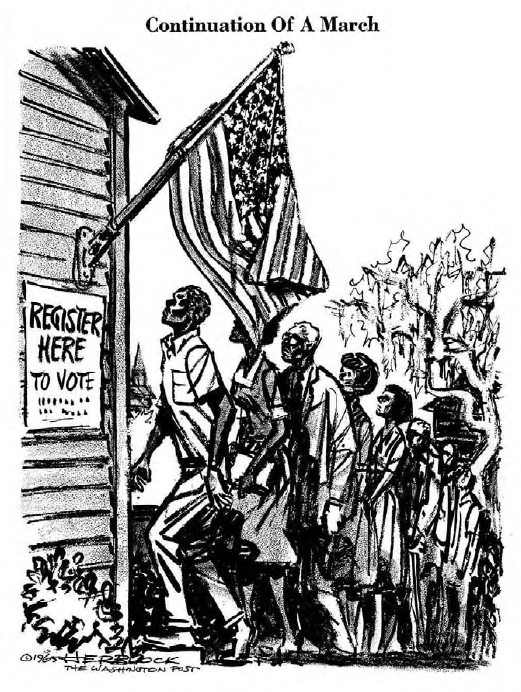
"President Lyndon Baines Johnson signed the Voting Rights Act of 1965 on August 6th, landmark federal legislation..."
|
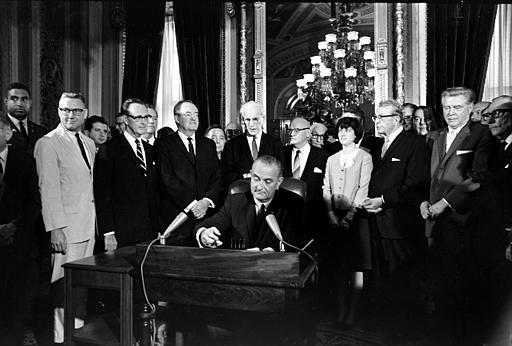
"U.S. President Lyndon B. Johnson signs the Voting Rights Act of 1965 in a ceremony in the President's Room near the Senate chambers in Washington, D.C., Aug. 6, 1965." (AP Photo)
|
Cartoons and captions courtesy of The Herb Block Foundation
Photographs courtesy of Associated Press
Photographs courtesy of Associated Press